the Tour de France in gernsbach at 2005 juli, 9th.

Tour through the old part of the town

Few paces from the platform „Gernsbach Mitte“ and the Tourist Information is a small passage where you can go through. Then you have the views on the historic Gernsbach. Already in 19th century this view was already a motif for artists. If you look up the surrounding mountains you’ll see the castle of the counts of “Eberstein”, the former feudal lord of the “Murg” Valley. Up the banks of the “Murg” you see the skyline of the old part of the town with its medieval buildings.

Historical Overview

The «Stadtbrücke»
The «Hofstätte»
The «Altes Rathaus» (The old town hall)
The «Kornhaus»
The «Liebfrauenkirche»
The «Storchenturm»
The «Wolkensteinischer Hof»
The «Turmgasse»
The «ehemalige Spital» (The former hospital)
The «Stadtmauer» (The town wall)
The «St. Jakobskirche»
The «Katz'sche Garten»
The «Schloßstraße»

townbridge1. The «Stadtbrücke»

The „Stadtbrücke”, a bridge crossing the “Murg”, already mentioned in 1505, was for many generations the only passage over the “Murg”. The „Stadtbrücke“ was the connection of the historic centre to the settlements “Igelbach” and “Bleich”. In the years 1823/24/25 the bridge was rebuilt from sandstone. In 1999 the bridge was extended with a wood and steel construction.

The mills, especially the mill next to the „Stadtbrücke“ called „Brückenmühle“ or „Grafenmühle“ had special importance because it had several grinding functions. Like the mill „Bogenmühle“ in the „Schlossstraße“ the „Brückenmühle“ had the exclusive right to grind the grain of this area.

>> top <<

2. The «Hofstätte »

The „Hofstätte“ was surrounded by historic half timbered buildings from the period of industrial expansion (1870). The “Hofstätte” was the centre of the settlements “Marktdorf”, “Kirchdorf”, “Gaß” and “Waldbach”.

There were up to six restaurants. The restaurants “Hirsch” and “Traube” are the oldest and still exist. In 1387 the counts of Eberstein had to share their rule with the margraves of Baden. The “Kondominatsbrunnen” (1511) a fountain was built to remember this event.

The entrance to the „Marktdorf“ was protected by the „Untere Tor“ with a draw bridge over the „Waldbach“ and a guard house. After a fire in 1787 the market place, as we know it today, was built. Only few buildings remain of the medieval town: the old town hall, a huge fountain with four water pipes and the vaults underneath the buildings.

>> top <<

The old town hall3. The «Alte Rathaus» (The old town hall)

The old town hall is one of the most important buildings of the late Renaissance in Southern Germany. It was built in 1617/1618 by the royal master builder Johann Schoch. The owner of the building was the famous rafter and wood trader Johann Jakob Kast. The interior of the building was generous and elegant. After the „Thirty Years’ War“ it became the town hall of Gernsbach until 1936.

Nowadays it is used for cultural events and for weddings because of its stylish atmosphere.

>> top <<

The Kornhaus4. The «Kornhaus»

After the big fire in 1798 the „Kornhaus“ was rebuilt according to the plans of an architect from Karlsruhe, the famous Friedrich Weinbrenner (1766 – 1826). He used ashlars from the tower next to the „Färbertor“ a former entrance to the town of Gernsbach.

Already in 1471 the „Kornhaus“ was mentioned as a magazine of the grain and fruit market. Through its history it was not only used as the Mayor’s office but also for other public services.


>>top <<


5. The «Liebfrauenkirche»

On the highest point of the old town you’ll see the church “Unserer lieben Frau”, which was remodelled in 1833. The origin of this church isn’t known. But people assumed that there was a chapel within a fortress. The interior dates from the late gothic period.

The old pilgrimage church was extended several times. But always was the solid built tower a part of the church building.

Like the „Storchenturm“ the tower belonged to the medieval fortress. At the beginning of the 18th century guns on the tower protected the western part of the town wall.

After the Reformation the Catholics received this church finally as their parish church. The interior renovation in 1970/1971 pushed the former sumptuous paintings aside.

>> top <<

The Storchenturm6. The «Storchenturm»

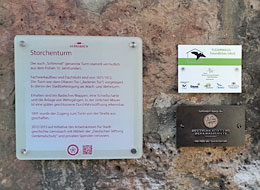
The „Storchenturm“ in front of the upper entrance of the town gate belongs like the Catholic steeple to the town fortress. A little sign of arms from „Baden“ shows us that it was built in 1449, but experts know that the construction of the tower is older.

The two outside gates of the guard tower, which are at the same level as the town wall indicates of existing battlements.So the „Storchenturm“ was connected with other towers of the medieval fortress. Since living memory it has always been called “Storchenturm” because until 1914 storks nested on top of the roof.

Sometimes people call the tower „Schimmel“ referring to an old name for fields. Today the „Arbeitskreis Stadtgeschichte Gernsbach“ regularly opens the tower to the public and presents a permanent exhibition on the topic “stork”.

>> top <<

7. The «Der Wolkensteinische Hof»

During the Palatine War of Succession the „Wolkensteinische Hof“ was destroyed by French troops. Only a side entrance and the flat of the servants and the warehouse survived.

A descendant of the nobel minnesinger from South Tyrol Oswald von Wolkenstein (he died in 1445), Baron Christoph von Wolkenstein married the countess „Maria von Eberstein“ in 1600. Soon afterwards he built this residence in the style of the Renaissance. The cellars received an entrance from the „Turmgasse“.

After the fire in 1798 a new building was erected on the land. The Kaltenbronn Forestry Office and the administration offices were housed until 1998 in these buildings. Today the „Wolkensteinische Hof“ is a private property.

>> top <<

The Turmgasse8. The «Turmgasse»

The old cobblestones lead the narrow windswept „Turmgasse“ to the „Storrentorstraße“ passing the cellars of the „Wolkensteinische Hof“ and the old prison.

It was given the same name as the town gate. The road through this entrance led to „Lichtental“ and „Baden-Baden“.

In former times people used the tower built upon the entrance as a gaol, until both had to pull down. The ashlars were used, in 1821 for the new prison and in 1843 for the reconstruction of the road to „Baden-Baden“.

>> top <<


9. The «ehemalige Spital» (The former hospital)

The former hospital in Waldbachstraße had a varied history. In 1654 a private family bought the house and the „Lohmühle“ a mill near by.

In 1831 during a cholera epidemic, the town made it into a hospital. Few years later the Katz family and a hospital fond together extended the hospital, which until 1912 existed.


>> top <<


view on the old town wall10. The «Stadtmauer» (The old town wall)

The old „Marktdorf“, first mentioned in 1219 was surrounded by a town wall with a ward, four entrances and several towers. In 1993 the town of Gernsbach reconstructed „Waldbachstraße“. Very narrowly standing houses were pulled down, so that people could see the run of the imposing town wall. Still remaining is the 1620 mill without a wheel; it is the last remaining kind in the Baden area.

On the town wall there are two impressive warehouses built in 1764 and 1784. The people stored their yields, to give to their feudal lord.

From here you turn into „Ebersteingasse“ and this takes you to „Hof“ the ancient „Kirchdorf“.

>> top <<


Chirch St. Jakob11. The «St. Jakobskirche»

The “St. Jakobskirche” was mentioned in 1219 and 1243. The west front was built from 1467 to 1471, later (1771) the ceiling of the nave and the vaults were renewed. You can date back the interior to the 15th and 16th century.

„St. Jakobskirche“ was the church of the counts of Eberstein. They were buried in the crypts underneath the chorus. During the Refomation the church was used by Catholics and Protestants. But since 1640 it has been a protestant church.

Out of this old settlement a narrow stair leads to „Schlossstraße“ or „Gaß“.

>> top <<


You may now decide:

If you want visit the „Katz’sche Garten“ so you have to pass „Hofstätte“ and „Stadtbrücke“ and then you have to turn left into „Bleichstraße“. Not far is the entrance of the garden with a wrought-iron gate underneath an arch of sandstone; it is the entrance to a well worth seeing baroque sculpture garden.


The Katz'scher Garten12. The «Katz'sche Garten»

In 1803 the private garden of the Katz family was designed by an Italian landscape architect. Because of the family’s passion of collecting you find in the garden many art monuments from the late gothic till the art nouveau.

From 1996 until 2001 the garden was newly designed by the help of volunteers together with the town administration. Now visitors can relax and recuperate in this charming Mediterranean atmosphere.

Further Information: http://www.katzscher-garten.de

>> top <<


The Alter Amtshof13. The «Schloßstraße»

When there is little time left, it is worthwhile to walk along “Schlossstraße”. It runs between „Murg“ and „Kirchdorf“ and leads to „Ebersteinbrücke“. In this medieval suburb not only craftsmen and traders settled down, also the bishopric of Speyer, the feudal-lord of this region. In 1556 the church council erected a building on medieval ruins. A complex of buildings, with cellars, and rooms for the cooper and a flat for the „Vogt“ (bailiff). He collected and managed the wine, paid as tax by the inhabitants of Gernsbach. In 1700 the half-timbered building was altered and sold. In 1990 the building was renovated and the town council of Gernsbach installed a museum for the history of the town.

At the end of the street is he „Bogen- or Schlossmühle“ which uses the river „Murg“ to generate power. Already on Christmas Eve in 1896 it produced the first electrical power for the inhabitants of the town.

The „Ebersteinbrücke“ passes into „Igelbachstraße“. If you pass the railway crossing you’ll find a vast park of a about 54,000 square meters. There is also a modern swimming pool where people can relax near nature.

Back in „Igelbachstraße“ you see again the skyline of the buildings and pediments in front of a picturesque landscape. You see now familiar buildings before you go to „Katz’sche Garten“ or to an interesting tour to the old part of Gernsbach.

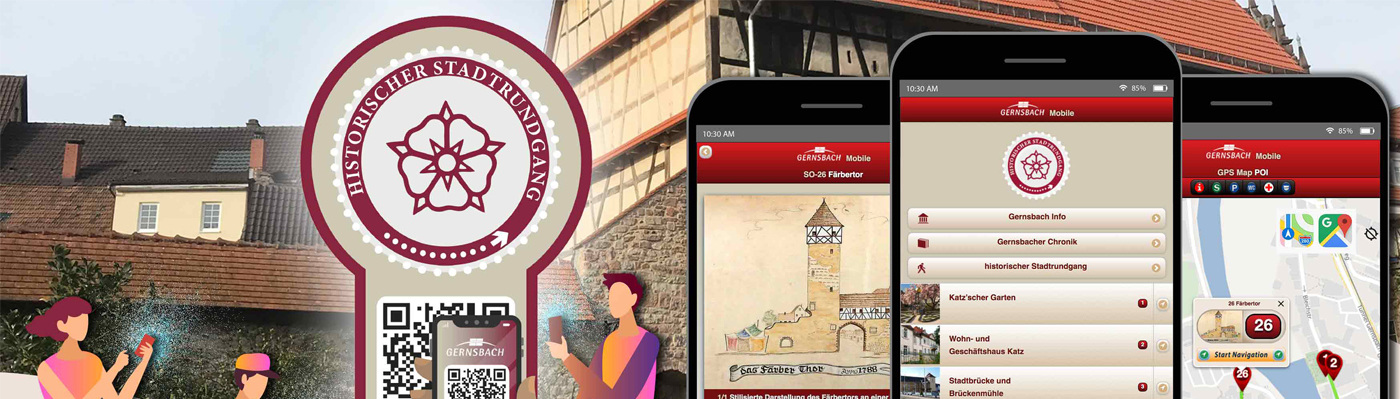
Additional to the described sights there are signs on the buildings, telling you about its history and function.

>> top <<


Historic overview – Gernsbach and its history

A small brief survey

1085
The counts of Eberstein settled in the area of „Oos“, „Alb“ and „Murg“.
They received this area from the bishopric Speyer. At the same time farmers from Franconia settled in the area of Gernsbach (farming and exploitation of the woods).

1219
Gernsbach was mentioned in a document as „Markt- and Kirchdorf“.

1243
Gernsbach received its own Parish and was called the first time a town.

1272
The first documented entry of the castle “Neu Eberstein” near Gernsbach, the ancestral seat of the counts of “Eberstein”.

1387
„Wolf von Eberstein“ sold half of the town Gernsbach to margrave “Rudolf VII of Baden“. Beginning of the common reign (“Kondominat”) of the town.

1417/1418
A fire destroyed Gernsbach. Reconstruction and confirmation of the right to be a town and the market-regulations.

1488
Regulations of the rafting and wood trade by the sovereign.

1556
The Reformation was due to alternation of religion for sovereign and inhabitants.

1583
Inhabitants of Gernsbach were liberated from serfdom.

1624
Inheritance brought the earls of Wolkenstein and Gronsfeld more influence in ruling the town.

1660
The family of the counts of Eberstein died out, because there was no male descendant. The dynasties of Baden and Wolkenstein and the bishopric of Speyer fought to be sovereign. During the course of the European wars of succession Gernsbach was repeatedly looted and pillaged.

1784
The forester of the newly founded forestry „Eberstein“ baron Friedrich Drais von Sauerbronn installed plant nurseries and began with reforesting the totally deforested areas.  1796 hHe installed a special school to study forestry.

1787/1798
Fires destroyed the medieval town. The architect Friedrich Weinbrenner (1766-1826) designed the reconstruction.

1803
Gernsbach belongs to „Baden“.

1849
At the end of the German Revolution there was an important fight in Gernsbach. The winning troops of the government occupied Gernsbach. Result: 29 dead persons and many destroyed buildings.

1857
Foundation of the Saving Bank Gernsbach. Start of the modern capital market.

1869
Railway connection between Rastatt and Gernsbach was finished. Industrialization and tourisme started.

1881
Foundation of the paper mill „Zellulosewerk Schulz & Cie“ later „Schoeller & Hoesch“. This was the year of birth of the paper industry in the „Murg“ Valley.

1913
No more rafting on the „Murg“.

1928
The railway through the „Murg“ Valley from Rastatt to Freudenstadt was finished.

1936
Gernsbach annexed Scheuern

1956
Opening of the first German school for paper manufacturing. International centre for paper, cellulose and corrugated cardboard. Seat of the professional associations of paper in “Baden-Württemberg”.

1964
Start of the twinning with Baccarat

1971
Staufenberg (1971), Lautenbach (1973), Obertsrot/Hilpertsau (1974) and Reichental (1975) were annexed by Gernsbach.

1979
The European flag was awarded due to the merit of the German-European friendship.

1997
After four years of construction the tunnel underneath Gernsbach was opened. Construction of the rehabilitation centre (about 200 beds) for heart and circulation patients. The conversion of the hospital into a clinic for geriatrics rehabilitation

1998
The Council of Europe in Strasbourg awards the „Europaplakette“.

2002
Opening of the new railway system Rastatt-Forbach.

>> top <<


Text: Winfried Wolf, Stadtarchiv Gernsbach